

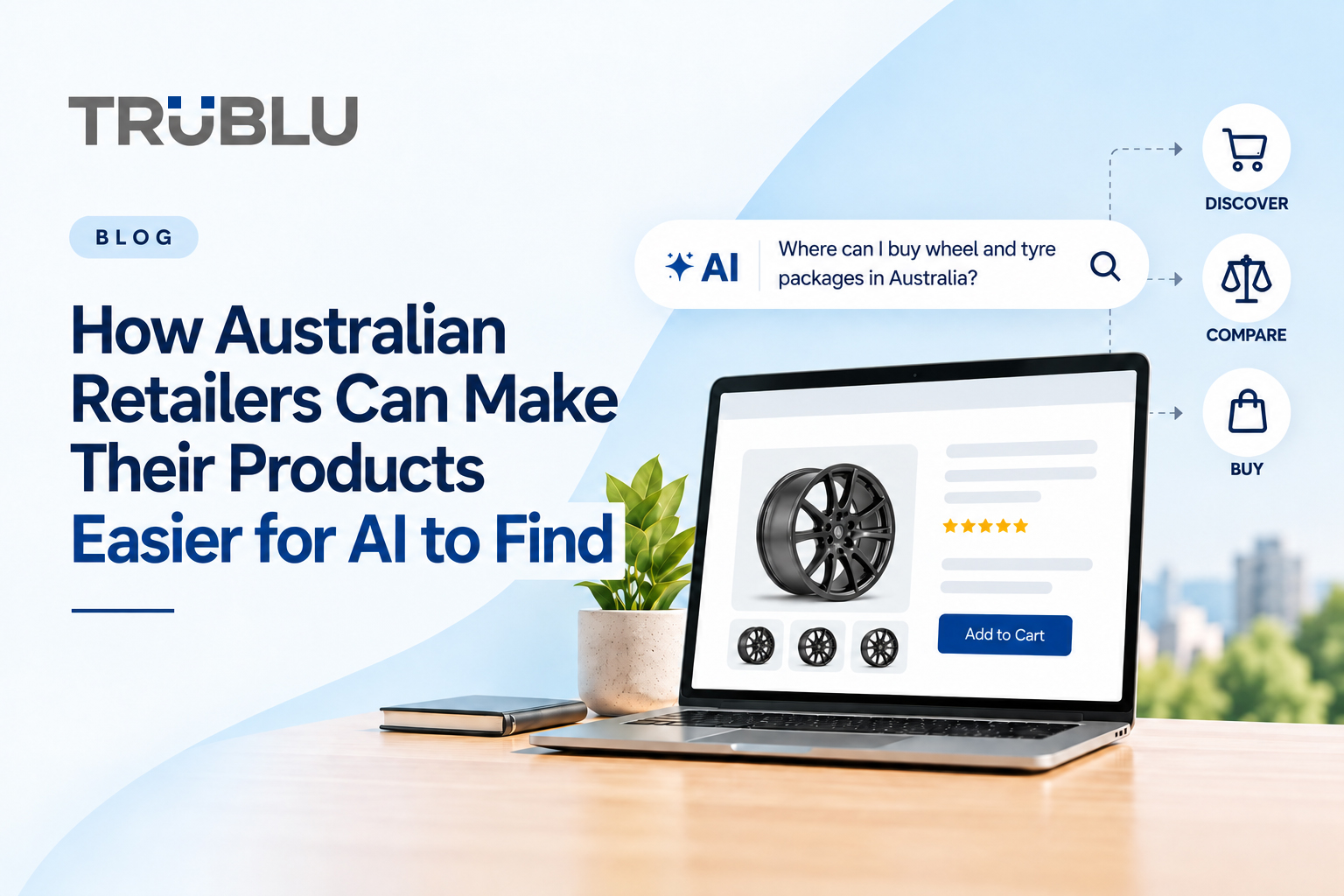
Australian retail is becoming more connected. Customers might discover a product through Google, compare it on a marketplace, check availability on a retailer’s website, and then choose between delivery and visiting a store.
As AI becomes part of that shopping journey, retailers have another reason to pay attention to how their products are presented online. A product that is difficult to understand, missing important details, or inconsistent across channels is harder for both customers and shopping systems to work with.
The good news is that preparing for AI shopping does not mean rebuilding your entire business. For many Australian retailers, it starts with something much more familiar: getting product information organised, accurate, and useful.
What does AI shopping mean for Australian retailers?
AI shopping refers to shopping experiences where artificial intelligence helps customers discover products, compare options, answer questions, or decide what to buy.
Instead of searching only for a product name, a customer might ask:
“Where can I find a durable black wheel and tyre package for my Ford Ranger?”
Or:
“What Australian retailers sell a waterproof jacket suitable for winter hiking?”
For a retailer, these questions create a simple challenge: can your product information answer what the customer is actually asking?
That means product data needs to do more than display a name and price. It should help someone understand what the product is, who it is for, and whether it meets their needs.
Why product data matters more than ever
Product data is the information that describes what you sell. It can include:
- Product names and descriptions
- Prices and availability
- Sizes, colours, and other variants
- Product specifications
- Images
- Categories and attributes
- Brand and supplier information
When this information is complete and consistent, customers have a clearer shopping experience. It also gives search engines, marketplaces, and other discovery systems more useful information to work with.
For Australian retailers, this is especially important when products have many variations. A fashion store might manage the same item across different sizes and colours. An automotive retailer might need to distinguish between wheel sizes, finishes, and vehicle compatibility. A beauty business may need to describe shades, formulas, and product types accurately.
The more specific the product, the more useful accurate information becomes.
1. Start with product names that explain what you sell
A product name should help a customer understand the item without needing to guess.
For example, compare:
Less useful:
Ranger Black
More useful:
Black 17-inch Alloy Wheel for Ford Ranger
The second name gives more context. It identifies the product type, an important specification, and the vehicle it is intended for.
This does not mean every product title needs to be long. The goal is to make names clear, specific, and natural.
For Australian retailers, useful naming conventions can include:
- Product type
- Brand or model
- Size or capacity
- Colour or finish
- Relevant compatibility information
A well-structured product name also makes it easier for staff to find products during checkout and for customers to understand what they are buying.
2. Give customers the details they need to make a decision
A short description is not always enough.
If someone is comparing two products, they may want to know:
- What is it made from?
- What size is it?
- What is it designed for?
- What makes it different?
- Is it suitable for their needs?
- What options are available?
For example, a tyre retailer should not rely only on a product name such as “All-Terrain Tyre.” Customers may also need information about size, load rating, intended use, and other relevant specifications.
The same principle applies across retail. A furniture retailer may need dimensions and materials. A fashion retailer may need fit and fabric information. A pet shop may need product type, size, and usage details.
Good product information answers the questions customers are likely to ask before they buy.
3. Keep product information consistent across your sales channels
Many Australian retailers sell through more than one channel. They may have a physical store, an ecommerce website, and marketplace listings.
The challenge is keeping product information accurate everywhere.
If a product has one price on the website and another in-store, or if a product is shown as available online when it has already sold, the customer experience suffers.
This is where connected retail systems become useful. Trublu’s omnichannel retail software is designed to connect POS, ecommerce, inventory, and other sales channels so product information and stock remain consistent across the business.
For retailers, the benefit is not just operational efficiency. It also means customers are more likely to see reliable information when they discover a product.
4. Organise products into clear categories and variants
A well-organised catalogue makes products easier to manage and easier to understand.
For example, a fashion retailer might organise products by:
Category → Product → Size → Colour
An automotive retailer might use:
Category → Wheel → Size → Finish → Vehicle compatibility
This structure helps retailers manage complex catalogues without creating unnecessary duplicate products.
Trublu’s cloud inventory software supports product categories, SKUs, variants, and stock attributes, helping retailers keep product information organised as their catalogue grows.
The important thing is to choose categories that reflect how customers actually shop. A product should be easy to find whether someone is browsing your website or asking a staff member for help in-store.
5. Use AI to improve product descriptions - but keep the information accurate
AI can help retailers create product descriptions faster, especially when managing a large catalogue.
For example, a retailer might provide basic product details and use AI to turn them into a clear, readable description. This can save time and help maintain a consistent writing style across product pages.
Trublu’s DIY ecommerce platform includes AI product description tools that help retailers create SEO-friendly product content from basic product details.
However, AI-generated content should always be checked before it goes live. A description should not invent specifications, make unsupported claims, or suggest that a product is suitable for a customer when that has not been confirmed.
AI can help write product information. It should not replace product knowledge.
6. Make your product pages useful for both customers and search
A product page should do more than include a keyword.
It should help a customer understand the product and decide whether it is right for them.
A useful product page may include:
- A clear product name
- A concise description
- Relevant specifications
- Product images
- Available variants
- Price and availability
- Shipping or collection information
- A clear next step
For Australian retailers, it can also be useful to include relevant local information, such as delivery options, click and collect, or store availability where applicable.
The aim is simple: make the page useful enough that a customer does not need to search elsewhere for basic information.
7. Keep your product data updated as your business changes
Product information is not something you set once and forget.
Prices change. Products go out of stock. New variants are added. Suppliers update specifications. Retailers expand into new channels.
If these changes are not reflected across the business, customers may see outdated information.
Trublu’s retail POS software connects product information with sales, inventory, and reporting, helping retailers keep product details and stock levels consistent across their retail operations.
For growing Australian retailers, this can make it easier to maintain a reliable catalogue without relying on manual updates across multiple systems.
8. Think about the questions your customers actually ask
One of the best ways to improve product information is to start with real customer questions.
Automotive retailer
- Will this wheel fit my vehicle?
- What tyre size do I need?
- Is this suitable for off-road driving?
Fashion retailer
- Does this come in other sizes?
- What is the material?
- Is it suitable for winter?
Furniture retailer
- What are the dimensions?
- Is assembly required?
- What materials are used?
Beauty retailer
- What is the product designed for?
- What shade options are available?
- How should it be used?
These questions can help you identify missing information on product pages and improve the way products are described.
The goal is not to write for AI instead of people. It is to write information that is useful to people and easy for systems to understand.
9. Connect product information with the rest of your retail business
Product discovery is only one part of the shopping journey.
Once a customer finds a product, they may want to check availability, place an order, collect it from a store, or buy it online.
That is why product information works best when it is connected to the rest of your retail operations.
Trublu brings POS, ecommerce, cloud inventory, payments, and reporting together in one platform. Its integrated ecommerce solution also supports online and in-store sales, product management, and inventory synchronisation.
For Australian retailers, this means the work you put into your product catalogue can support more than search visibility. It can also help create a smoother experience from product discovery to purchase.
10. Build a simple AI-ready product data checklist
You do not need to change everything at once.
Start with your most important products and work through a simple checklist:
- Is the product name clear?
- Are the main specifications included?
- Are variants organised correctly?
- Are prices and availability accurate?
- Are product images useful?
- Is the product description easy to understand?
- Is the information consistent across sales channels?
- Can customers find the product through your website search?
- Are there any common customer questions that the page does not answer?
Once the basics are in place, you can improve your catalogue gradually.
What Australian retailers should focus on next
AI shopping is still developing, but the underlying principles are familiar: accurate information, useful product pages, consistent data, and a connected retail experience.
For Australian retailers, the opportunity is to make their products easier to discover without losing the human side of retail.
A customer should be able to find a product, understand it, check whether it is right for them, and buy it with confidence.
That starts with better product information.
Ready to make your retail operations more connected?
Trublu helps Australian retailers manage products, inventory, ecommerce, POS, and sales channels from one connected platform.