

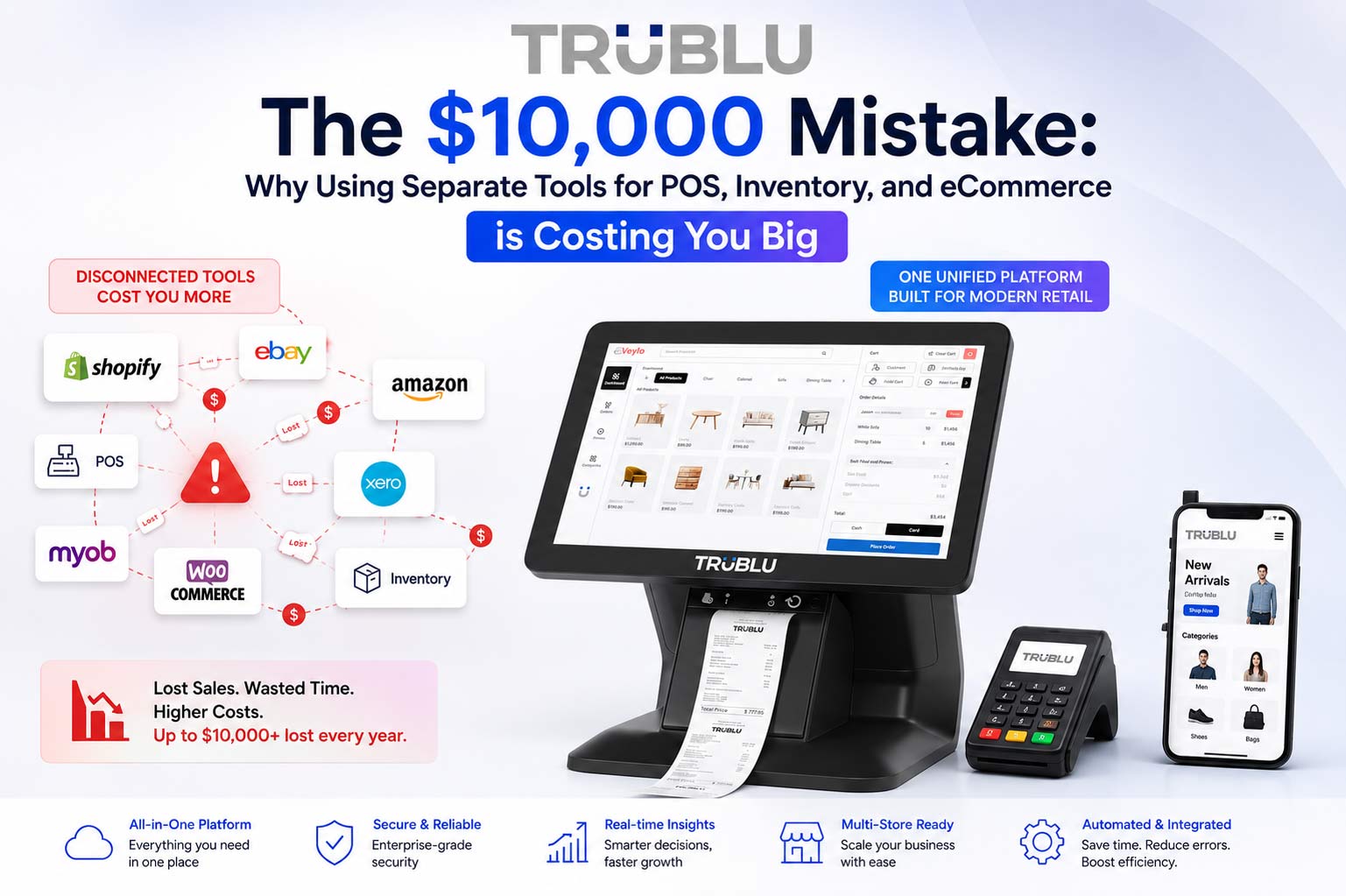
The $10,000 Mistake: Why using separate tools for POS, inventory and eCommerce is costing you big
Ask any Australian retail business owner what their most valuable asset is, and they’ll likely say their stock or their staff. But there’s a third asset that quietly dictates whether a business scales or stalls: their technology.
In the early days of opening a retail shop, it makes sense to keep things simple. You pick an easy point-of-sale app for the counter. When you launch your online store, you sign up for Shopify or WooCommerce. To expand your reach, you open an eBay or Amazon seller account. Finally, you link up Xero or MYOB to handle the tax invoices.
Before you know it, you are running four, five, or six different software subscriptions. On paper, it looks like a modern digital setup. In reality, it’s a ticking financial time bomb.
Using disconnected, separate tools for your retail operations is a classic trap - and it is easily a $10,000 mistake hidden inside your monthly operational budget. Here is exactly how this fragmented retail tech is quietly draining your profits, and the simple way to fix it for good.
The hidden drain: How disconnected systems leak your cash
When your retail systems don't talk to each other, your business suffers from structural leaks. These aren't just minor inconveniences; they are direct hits to your bottom line.
1. The manual labor tax (Hours wasted on data entry)
If your counter sales system doesn't automatically talk to your accounting ledger or your website inventory, who bridges the gap? You do. Or worse, an employee you are paying by the hour does. Spending hours manually typing daily sales reports into spreadsheets, updating stock levels across multiple tabs, or double-checking bank transactions at midnight is a massive waste of human capital. Every hour you or your team spends playing "data messenger" between apps is an hour stolen from marketing, customer service, and growing the business.
2. The cost of "Ghost stock" and canceled orders
Imagine an online customer buys a specific automotive spare part or fashion item on your website at 8:00 PM. But your physical storefront sold that exact item off the shelf at 3:00 PM. Because your systems aren't synced in real time, your website thought the item was still available.
Now, you have to email the customer, apologize, issue a refund, and manually reverse the transaction. You haven't just lost a sale; you've permanently destroyed customer trust and wasted marketing dollars acquiring a buyer you had to turn away.
3. Subscription creep
Software applications love to charge monthly fees. $50 for this plugin, $90 for that tracking app, $120 for an inventory add-on. When your retail tech is fragmented, you pay multiple software companies for overlapping features. Over a year, this subscription creep quietly adds up to thousands of dollars in unneeded operational costs.
Enter the "Unified frontline engine"
Successful Australian retailers are moving away from messy software webs and adopting what industry experts call a Unified frontline engine.
Instead of trying to patch together disjointed apps using buggy third-party plugins, a unified frontline engine brings your entire business into one single cloud interface.
When a customer taps their card at your physical store counter, your retail management system instantly updates your brick-and-mortar ledger, subtracts the item from your eCommerce store, adjusts your eBay stock levels, and prepares the tax invoice data for your accounting platform - all in under a second, with zero manual work.
Why modern aussie retailers are consolidating their tech stack
Switching to an all-in-one integrated POS software layout completely changes how a business operates:
- Complete inventory transparency: You gain total clarity. You can look at a single screen and see exactly what stock is sitting in your back room, on your retail shelves, or in transit, reducing the risk of dead stock.
- Flawless financial reconciliation: No more end-of-day math headaches. Every transaction, split-payment, or customer refund automatically links back to its corresponding ledger account, making your quarterly BAS submission incredibly straightforward.
- A scalable retail footprint: When your back-end operational infrastructure is unified, adding a second physical store, a new warehouse, or launching onto a new marketplace platform takes a few clicks rather than a complete system overhaul.
How to fix your fragmented tech layer today
If you are tired of juggling multiple tabs, paying separate software bills, and dealing with constant inventory errors, it's time to simplify your retail framework.
Investing in a comprehensive, localized platform like Trublu gives your retail brand a robust, cloud business software foundation engineered specifically for Australian commerce realities. Trublu combines high-speed physical point of sale software, live multi-location cloud inventory control, native omnichannel integrations (Shopify, Amazon, Xero, MYOB), and integrated payments into one unified, low-maintenance dashboard.
Stop paying the fragmentation tax. Bring absolute structural clarity, safety, and efficiency back to your business operations.
Ready to centralize your retail business?
Ditch the software headaches and protect your margins. Sign up for Trublu POS now and see how easy managing your store can truly be.